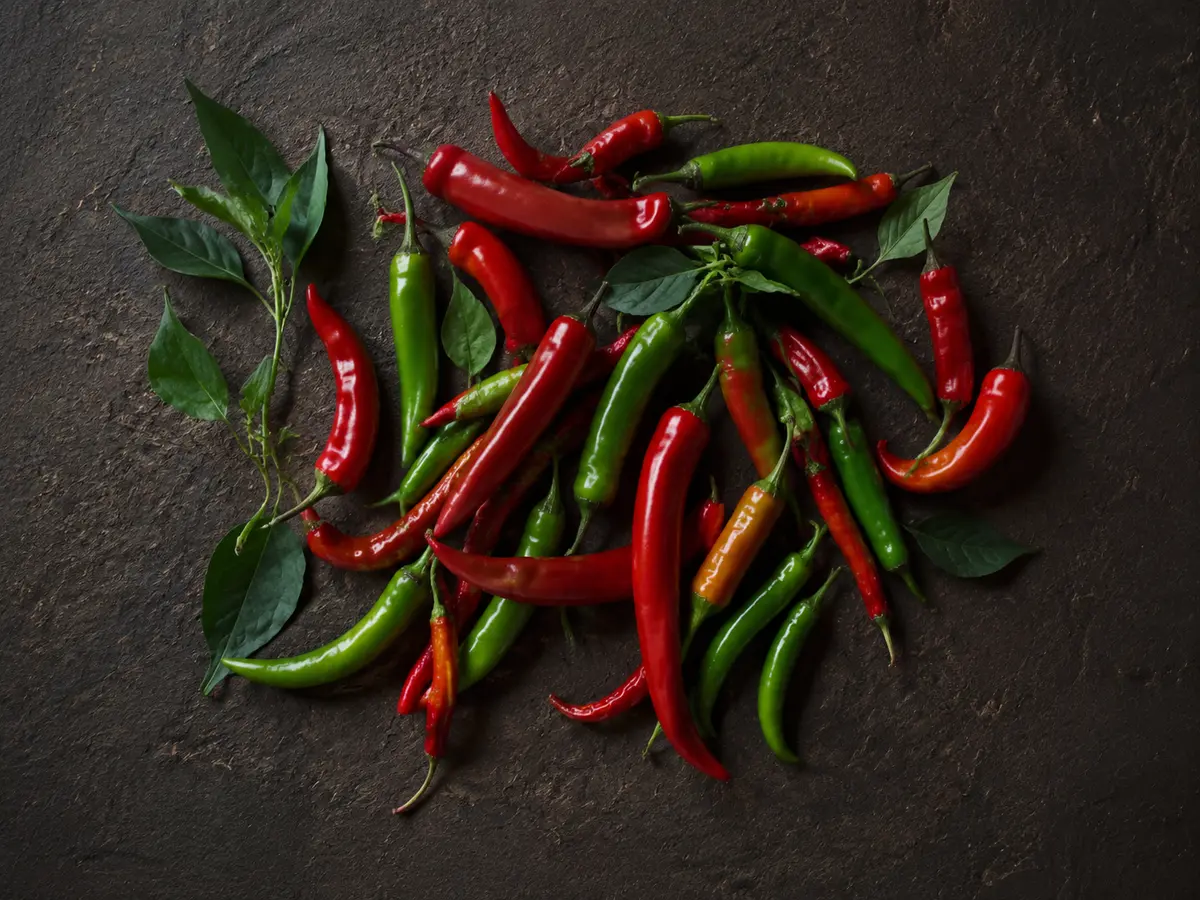
The red comes from pigments such as capsanthin and capsorubin; the heat comes from capsaicinoids, a different group of compounds. The two often rise together during ripening, but they are not the same scale. When green and red fruit hang on the same plant, here is what actually decides which one is hotter.
Green to red: color records ripeness
Young peppers are green because their fruit cells contain abundant chlorophyll. During ripening, chlorophyll and photosynthetic activity decline while the carotenoid profile changes dramatically. In red-ripening cultivars, pigments including capsanthin and capsorubin accumulate to create the final red color.
Not every pepper finishes red. Depending on the cultivar, ripe fruit may be yellow, orange, brown or purple. “Green is an earlier stage; the cultivar’s final color is ripe” is useful. “All ripe peppers are red” is not.
How does pungency change during ripening?
Most pepper heat comes from capsaicinoids, especially capsaicin and dihydrocapsaicin. In a study spanning multiple varietal types and growing systems, nearly all accessions had similar or higher total capsaicinoids when fully ripe than at the mature-green stage.
Across the fruit’s entire life, though, the increase is not perfectly linear. Many cultivars accumulate capsaicinoids during early development, reach a maximum shortly before or around ripening, then remain stable or lose some through degradation. One study of ornamental peppers recorded a decline exceeding 30 percent late in ripening for a particular line.
| OBSERVATION | WHAT IT TELLS YOU | WHAT IT CANNOT TELL YOU |
|---|---|---|
| Green fruit | Usually not at its cultivar’s final color | It is not necessarily mild |
| Red fruit | A red-ripening cultivar is near maturity | It is not guaranteed hotter than its green stage |
| Same cultivar | Ripeness comparisons can be useful | Individual fruits will not be identical |
| Different cultivars | Color can suggest maturity | Color cannot rank their heat |
Are the seeds the hottest part?
Strictly speaking, the hot spot is the placenta: the pale tissue to which the seeds attach, together with the inner septa. Studies repeatedly find much more capsaicinoid in placental tissue than in the outer wall. Seeds feel hot largely because compounds from the neighboring tissue coat their surface.
To reduce heat, remove the pale placenta and inner ribs along with the seeds. To compare two fruits more fairly, sample the same position near the placenta rather than comparing arbitrary pieces from the tips.
Why peppers of one cultivar still vary
- Genetics. Cultivar is the strongest baseline. A sweet pepper that produces almost no capsaicinoids will remain sweet when red.
- Ripeness. Pungent compounds increase through ripening in many cultivars, but each has its own peak and decline pattern.
- Water and temperature. Water stress, temperature and other environmental factors can alter capsaicinoid accumulation, with responses varying by genotype and stress intensity.
- Fruit-to-fruit variation. Position and development differ even on one plant, so equally colored fruit can taste different.
Cross-pollination between a hot and sweet pepper also does not change the heat of fruit already growing this season. The genetic result appears when seed from that fruit is planted as the next generation.
Choose the harvest stage for your purpose
For crisp green peppers
Pick when fruit has reached the expected cultivar size, feels firm and has a glossy surface. Harvest before the color break when crisp texture and a fresh green character matter most.
For fully ripe peppers
Wait until the cultivar’s final color develops well. Sweetness and aroma generally become fuller. For drying or seed saving, choose healthy, disease-free fruit that matured completely on a vigorous plant.
When heat is the goal
Trust the cultivar record before the color. Within one cultivar, compare small samples from green and ripe fruit, then record the stage and harvest date you preferred. That personal growing record is more accurate than assuming every red pepper is hotter.