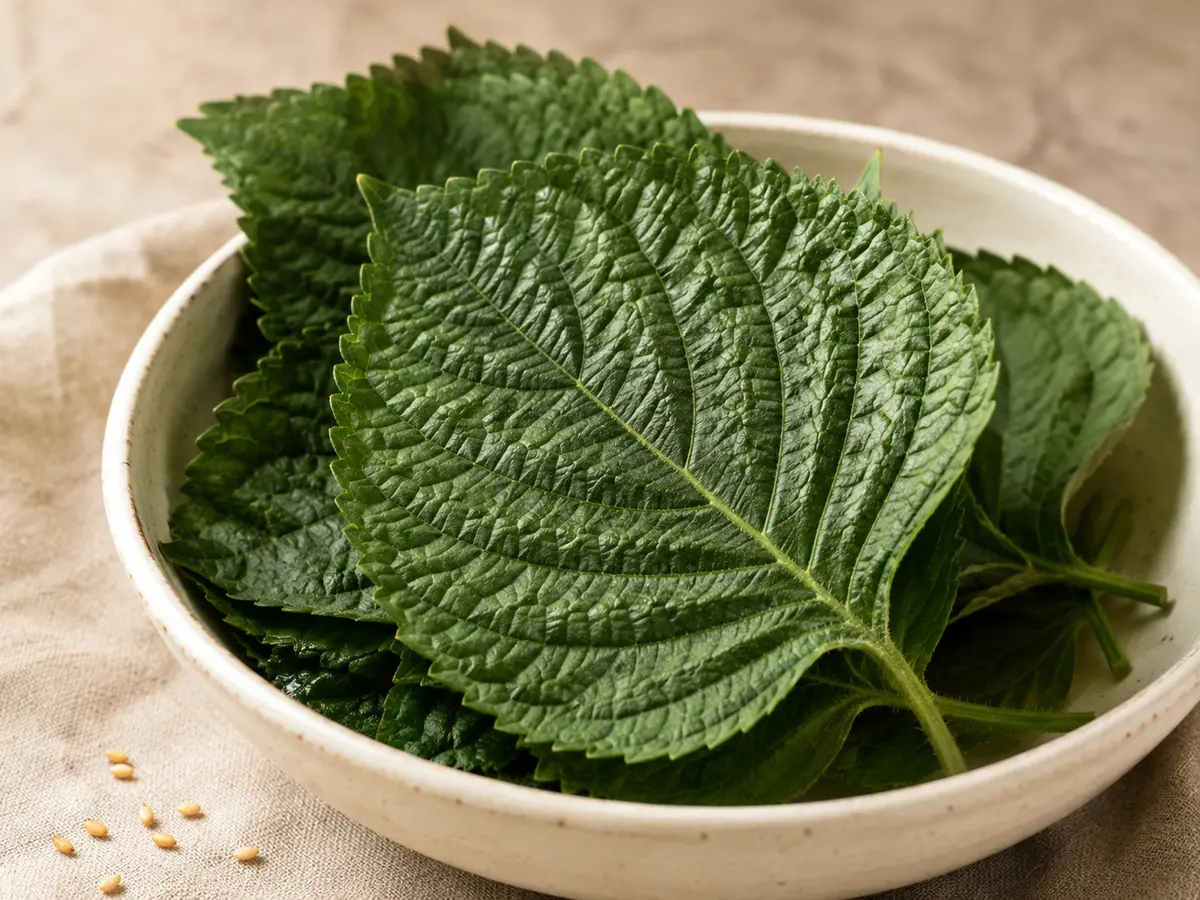
Online stores and overseas markets often blur the labels perilla, shiso and Korean sesame leaf. Because the plants look similar, it is easy to assume these are simply national names for one vegetable. That assumption can leave you with the wrong aroma, leaf size or culinary result.
Two crop groups within one species
Kew’s Plants of the World Online recognizes both var. frutescens and var. crispa beneath Perilla frutescens. A genetic study of East Asian perilla crops found that the two cultivated forms can be crossed artificially, yet each formed a distinct cluster—close, but not identical.
Do not identify every plant from a single leaf, however. Research comparing accessions from Korea, Japan and China found that classification becomes clearer when several traits—leaf and seed size, fragrance, color and hairiness—are considered together. Green, red, flat and crinkled cultivars, regional lines and occasional hybrids create overlap.
Korean perilla and shiso at a glance
| FEATURE | KOREAN PERILLA | JAPANESE SHISO |
|---|---|---|
| Typical classification | P. frutescens var. frutescens | P. frutescens var. crispa |
| Common names | Kkaennip, deulkkae Korean perilla leaf | Aojiso or oba (green) Akajiso (red) |
| Leaf tendency | Usually broader, larger and comparatively flat | Often smaller and more pointed; some cultivars are strongly crinkled |
| Aromatic impression | Deep, green, nutty-herbal; often compared with mint | Brighter and sharper; some cultivars suggest citrus or anise |
| Signature uses | Ssam, soy pickles, leaf kimchi, jeon and namul | Sashimi garnish, yakumi, shredded topping, shiso-maki and red pickles |
| Role at the table | A leafy vegetable eaten generously as well as an herb | An aromatic herb and garnish often used in smaller amounts |
These are useful tendencies, not a visual identification key. Leaf size, color and aroma overlap among cultivars and growing conditions. “Large means Korean perilla” is not a reliable rule on its own.
The culinary difference is the clearest one
Korean perilla behaves like an edible leaf
In Korea, a whole leaf wraps rice and grilled food; stacks are seasoned in soy sauce; leaves are filled and pan-fried. The vegetable contributes flexibility, surface area and texture, not just fragrance. Broad, tender cultivars that tolerate repeated harvest are particularly useful.
Shiso often behaves like a finishing herb
Japan’s Ministry of Agriculture describes green shiso, or oba, as a garnish and savory vegetable served with sashimi, while red shiso is used in pickles such as umeboshi. Dishes such as shiso-maki do use the whole leaf as a wrapper, but everyday usage frequently emphasizes a concentrated aromatic accent.
Can you substitute one for the other?
Yes when aroma matters, but the result will not be identical. Shiso can provide a recognizable perilla-family direction when Korean perilla is unavailable. Because its fragrance may feel sharper, begin with about half the amount and taste before adding more.
- For ssam. If shiso is too small, use a broad lettuce as the wrapper and add part of a shiso leaf for aroma.
- For soy-marinated leaves. Thin shiso may soften faster than a substantial Korean perilla leaf. Test a small batch before committing the whole bundle.
- For garnish. When replacing shiso with Korean perilla, cut it very finely and use less so the deeper aroma does not dominate.
- For jeon. Small shiso cannot fully replace the structure of a broad stuffed perilla leaf. Split the structural and aromatic jobs between two ingredients.
When buying seeds, look beyond the word “perilla”
- For Korean-style leaves, look for Korean perilla, kkaennip, deulkkae or var. frutescens.
- For Japanese shiso, look for green shiso, aojiso, oba, red shiso, akajiso or var. crispa.
- Sesame leaf is a conventional mistranslation of kkaennip. It is not the leaf of true sesame, Sesamum indicum.
- Confirm whether the cultivar is green or red, flat or crinkled, and sold for culinary rather than ornamental use.
The best question is not which leaf is more “authentic,” but which combination of size, texture and aromatic intensity your dish needs. These close relatives resemble each other because of shared ancestry and differ because cooks and growers selected them for distinct food cultures.